Главная » Fountain Layout Design: Principles, Water Effects, and Visual Planning

Fountain Layout Design: Principles, Water Effects, and Visual Planning

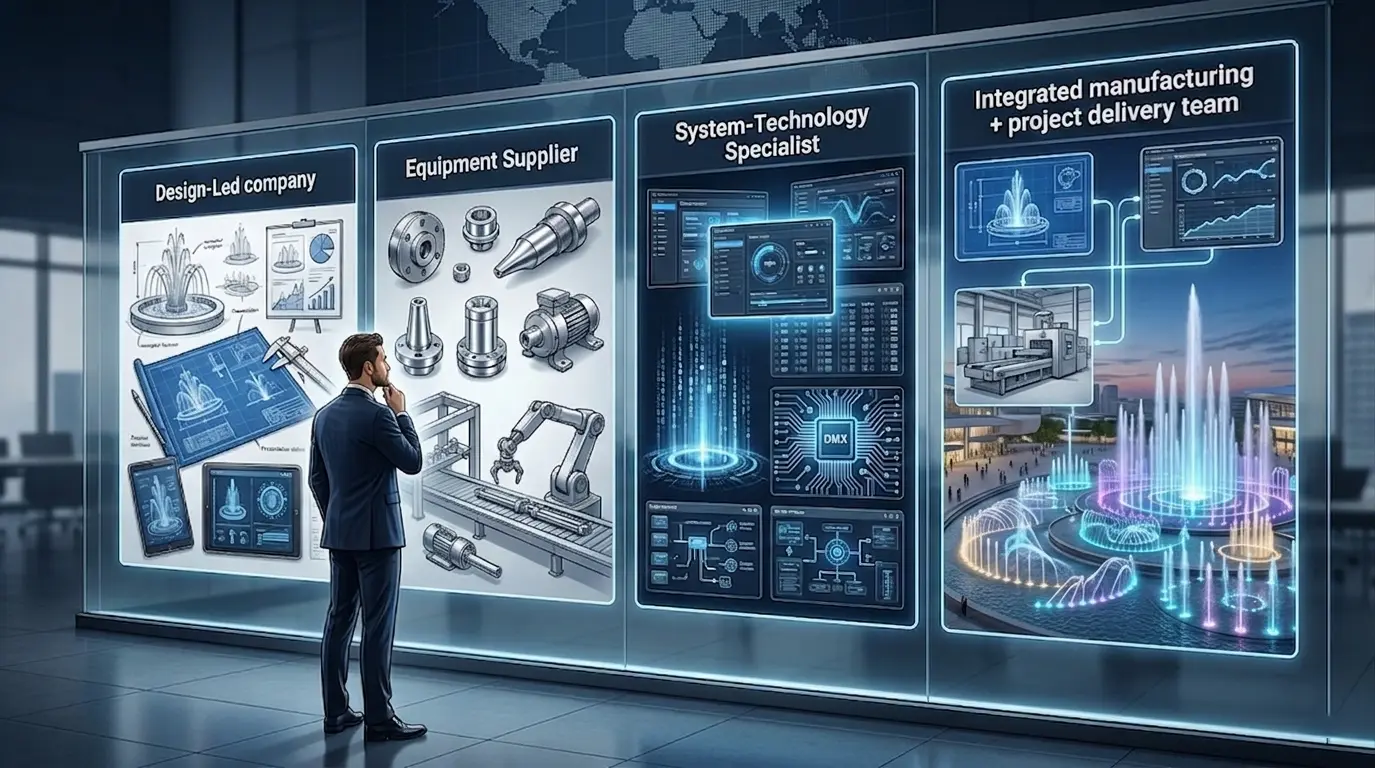
A good fountain design is not only about choosing attractive water effects. It also requires clear layout planning, proper scale, balanced visual rhythm, and practical engineering coordination.

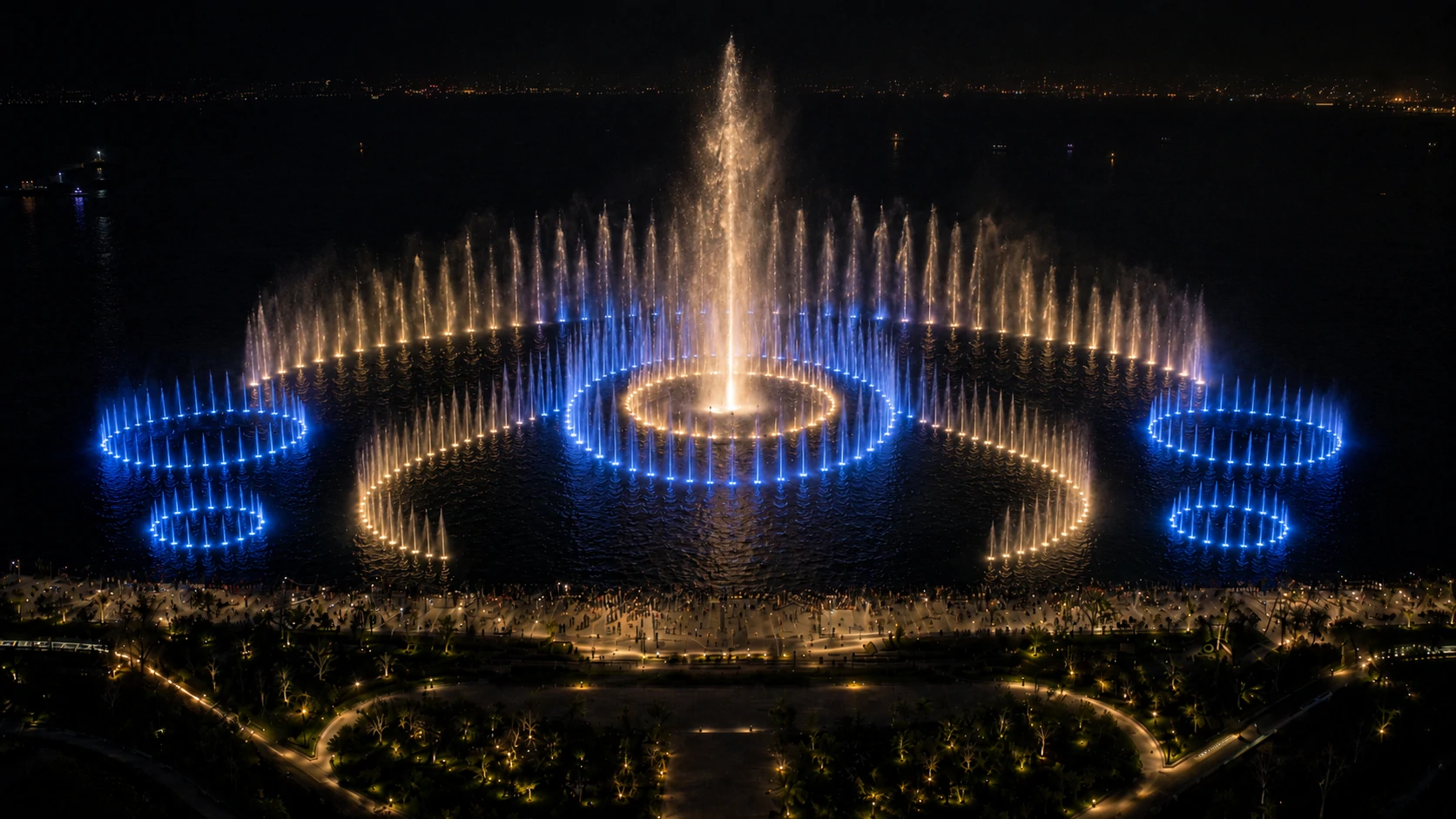
Fountain layout design showing a large circular fountain with multiple water effects and lighting.
Fountain layout design showing a large circular fountain with multiple water effects and lighting

Fountain design is not only about selecting beautiful nozzles or impressive spray heights.
A good fountain project needs a clear layout. It also needs balanced water effects, proper scale, stable performance, and a strong relationship with the surrounding space.
In many projects, the fountain is the visual center of a plaza, hotel, park, commercial area, or public space. Its layout affects how people see the site, how they move around it, and how they remember the place.
This article explains the key principles of fountain layout design. It also looks at water effects, visual balance, lighting, music, reflection, and practical planning.

Why Fountain Layout Design Matters

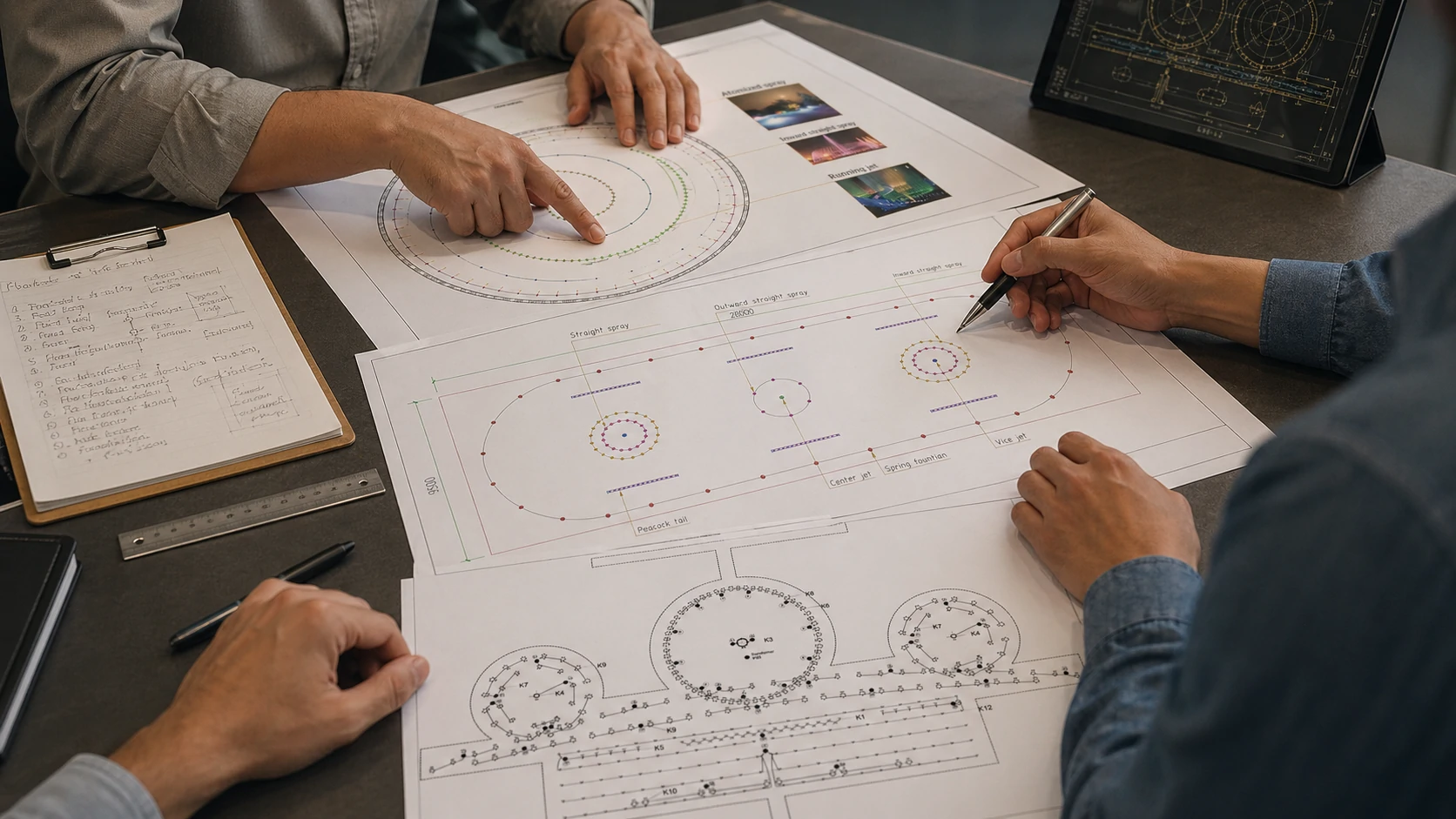
Engineers discussing dancing fountain layout and hydraulic design for a large-scale fountain project

Fountain layout design is the foundation of a successful fountain project.
Before choosing the final water effects, designers need to study the site. They need to understand the pool shape, viewing direction, surrounding buildings, walking routes, and project purpose.
A fountain in a formal public square may need a stable and symmetrical layout.
A fountain in a resort may need a softer, more relaxed feel.
A fountain in a commercial center may need a stronger visual impact and nighttime attraction.
The same water effect can create very different results in different spaces. This is why layout planning should come before equipment selection.

Unity and Variety in Fountain Design

Unity and variety are two basic principles in fountain design.
A fountain should not look random. The water effects, spray heights, colors, and movement should follow a clear visual order.
At the same time, the design should not be too simple. If every water effect looks the same, the fountain may feel flat and boring.
Good fountain design uses variety within a unified structure.
For example, the layout may use repeated straight jets to create order. Then it may add swing jets, central high jets, or fan-shaped effects to create rhythm and focus.
Unity gives the project a clear identity.
Variety makes the fountain more vivid and memorable.

Practical Design Advice

Do not add too many unrelated effects into one pool.
A strong fountain design usually has a main visual idea. Other effects should support that idea instead of competing with it.

Symmetry and Balance

Symmetry and balance are often used in fountain layout design.
They help create order, stability, and visual comfort.

Symmetrical Layout

A symmetrical fountain layout usually has a clear central axis. The water effects on both sides are similar or identical.
This approach is suitable for:

city squares
government buildings
hotel entrances
formal gardens
memorial spaces
commercial plazas with a strong central view

A symmetrical layout often gives people a feeling of dignity, order, and importance.

Balanced Layout

Balance does not always mean full symmetry.
In some projects, the pool shape may be irregular. The site may also have different viewing directions. In this case, the designer can use visual balance instead of strict symmetry.
For example, a taller spray group on one side can be balanced by a wider group of lower effects on the other side.
Balanced design is useful for parks, resorts, lakes, and open public spaces.

Contrast and Coordination

Contrast makes a fountain more exciting.
Coordination keeps the fountain from becoming chaotic.
A fountain can use contrast in many ways:

high jets and low jets
strong movement and calm water
bright lighting and soft lighting
straight lines and curved lines
fast rhythm and slow rhythm
wide water effects and narrow water effects

However, contrast must be controlled.
If the contrast is too strong, the fountain may feel messy. If there is no contrast, the fountain may feel dull.
A good fountain design uses contrast to highlight the main effect. It uses coordination to connect all effects into one complete visual system.

Example

A central high jet can become the focus of the fountain. Around it, lower jets and fan-shaped effects can support the main spray.
This creates a clear visual hierarchy.

Abstract and Figurative Expression

Fountain effects can be abstract or figurative.
Abstract design focuses on rhythm, movement, lines, height, and visual feeling. It does not need to copy a real object.
Figurative design is closer to natural or symbolic forms. For example, some fountain effects may look like flowers, fans, waves, arches, or a peacock tail.
Both methods can work well.
The key is whether the design fits the project theme.
A cultural project may use symbolic water effects.
A commercial project may use strong and dynamic effects.
A resort project may use softer movement and a more relaxed rhythm.
The fountain does not need to imitate nature exactly. It should use water to express the right atmosphere.

Proportion and Scale

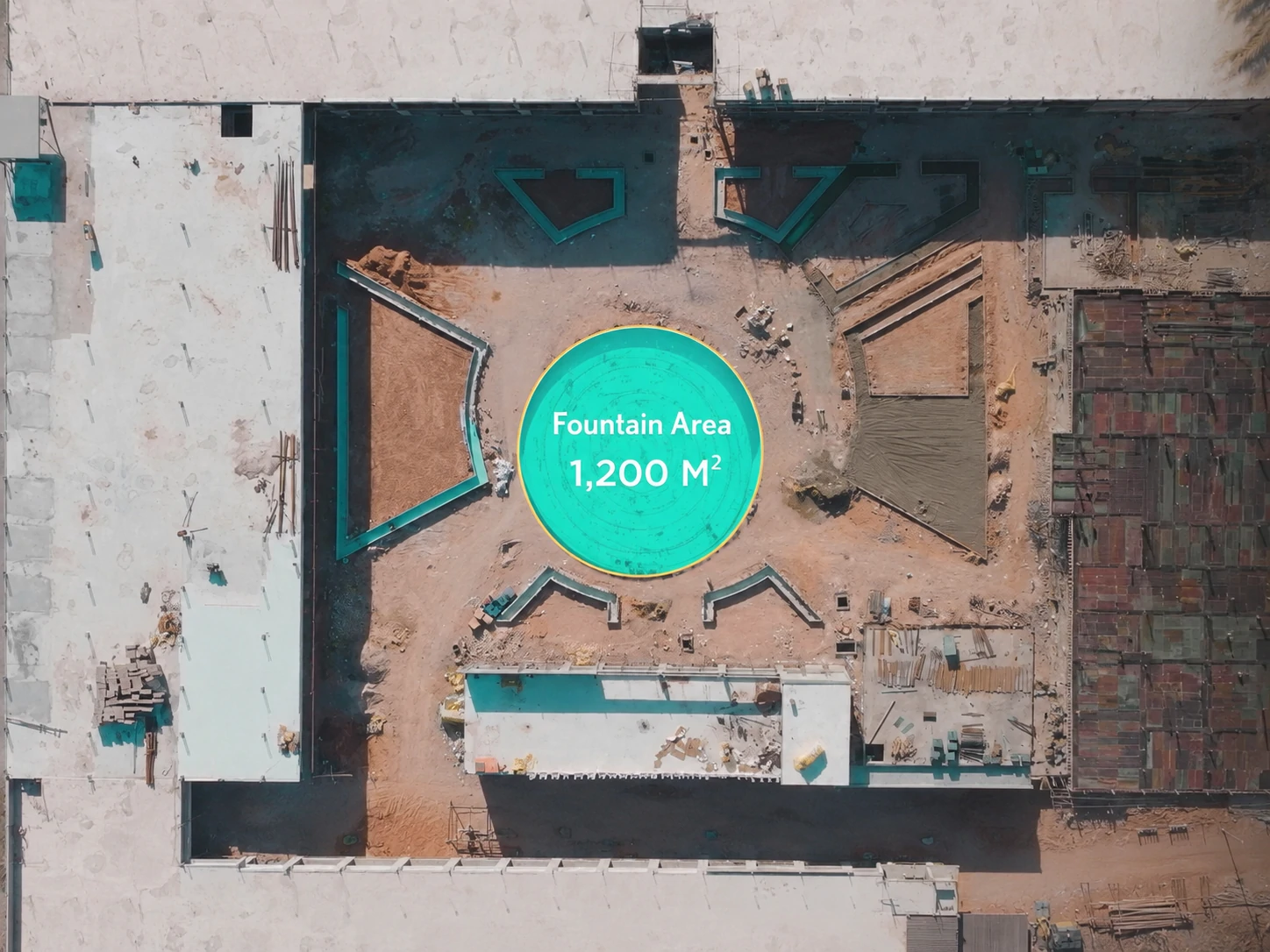
Aerial view of the 1,200 square meter circular fountain area under construction at Furat Mall in Najaf, Iraq.

Proportion is very important in fountain design.
The fountain should match the size of the pool, the surrounding buildings, and the viewing distance.
A spray height that looks impressive in a large square may feel too strong in a small courtyard.
A low fountain may disappear in a wide open space.
Designers need to consider:

pool size
spray height
viewing distance
surrounding building height
walking distance from visitors
wind conditions
safety distance
maintenance access

Good proportion makes the fountain feel comfortable and natural.
It also helps control cost and technical difficulty.

Common Fountain Water Effects

Different water effects create different visual feelings.
Some effects are calm and elegant. Some are dynamic and powerful. Some are suitable for formal spaces. Others are better for entertainment or night shows.
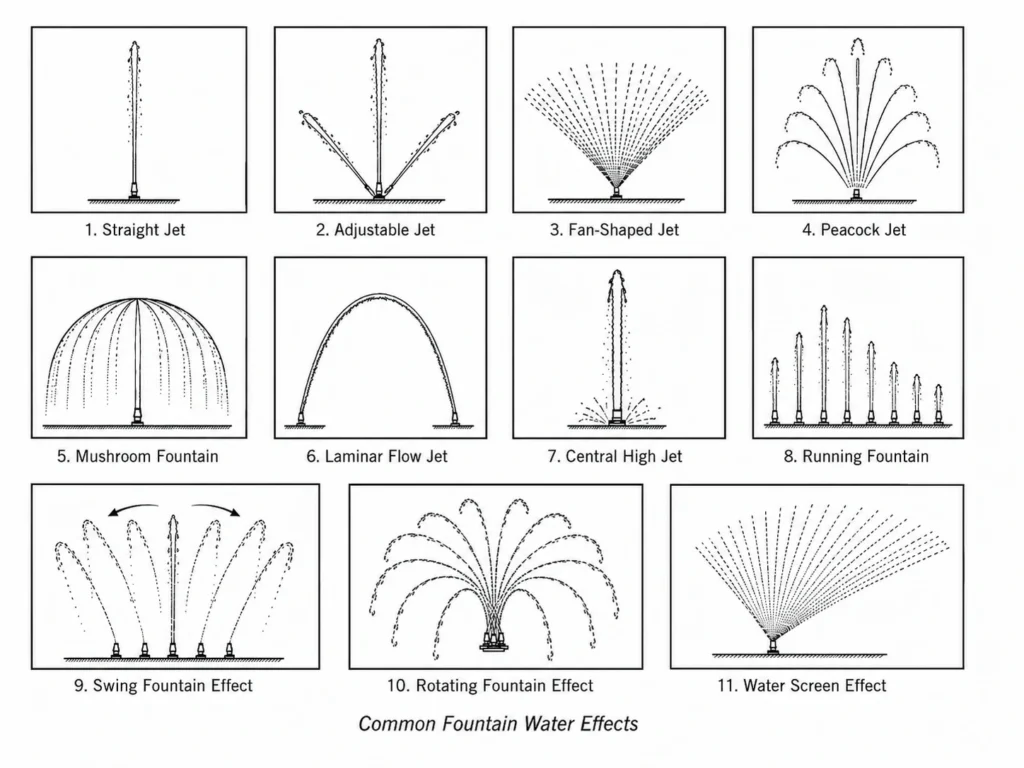
Below are common fountain effects used in fountain project design.

Sketch diagram of different fountain water patterns, including jets, fans, arches, domes, and rotating effects.
Fountain EffectVisual CharacterCommon Use
Straight JetClean, simple, verticalFormal layouts, central axis, rhythm lines
Adjustable JetFlexible spray angleFine-tuning, special layouts
Fan-Shaped JetWide and decorativePool edges, visual layers
Peacock JetOpen and elegantDecorative scenes, theme design
Mushroom FountainSoft and completeEntrance pools, family-friendly spaces
Laminar Flow JetLight and rhythmicWalkways, pool crossings, interactive areas
Central High JetStrong focal pointMain visual center
Running FountainDynamic and sequentialMusic fountain shows, commercial spaces
Swing Fountain EffectMoving and expressiveDancing fountain shows, stage-like layouts
Rotating Fountain EffectRich and eye-catchingNight shows, landmark projects
Water Screen EffectMultimedia displayProjection, tourism, event shows

Not every effect is suitable for every project.
The final selection should depend on the pool size, project atmosphere, viewing angle, budget, and control system.

Design Methods for Fountain Effects

Fountain effects can be designed in different ways.
The most common methods include imitation, symbolism, and mood-based design.

Imitation

Some fountain effects are inspired by natural forms.
They may remind people of flowers, waves, rain, mist, springs, or flying birds.
This method is easy for visitors to understand. It also helps create a friendly and lively atmosphere.

Symbolism

A fountain can also express a symbolic meaning.
For example, upward jets may suggest growth and energy.
Circular layouts may suggest unity and gathering.
Layered effects may suggest celebration, progress, or movement.
This method is often used in public spaces, cultural projects, and city landmarks.

Mood-Based Design

In some projects, the fountain is designed to create a certain mood.
A calm fountain can make a space feel quiet and elegant.
A dynamic fountain can make a space feel active and festive.
A multimedia fountain show can create a strong sense of event and attraction.
The water effect should support the emotional goal of the project.

Spray Height, Range, and Movement

Spray height and spray range are not only visual decisions. They are also engineering decisions.
A fountain designer needs to consider how the water behaves in real conditions.
Important factors include:

visual effect of the spray
stable height under normal wind conditions
spray range on the water surface
water pressure
nozzle type
movement speed
splash control
safety around the pool

A higher jet is not always better.
If the spray height is too high for the site, wind may carry water outside the pool. This can affect visitors, paving, lighting, and nearby equipment.
Movement also needs control.
Fast movement can create excitement. Slow movement can create elegance. The right rhythm depends on the project purpose.

Choosing Fountain Effects for Different Project Atmospheres

A fountain should match the atmosphere of the site.
Different project types need different water effect combinations.

Project TypeSuitable Design Direction
Public PlazaStable layout, central focus, clear symmetry
Commercial CenterDynamic effects, strong night view, music rhythm
Hotel or ResortElegant movement, soft lighting, comfortable scale
Real Estate ProjectBalanced visual effect, good daytime and night view
Cultural Tourism ProjectTheme-based design, multimedia effects, storytelling
Park or Lake AreaNatural rhythm, wide viewing angle, softer transitions
Event SpaceStrong show effects, lighting, music, programming

A good fountain design should not only look beautiful in drawings. It should also work well in the real site.

Lighting, Music, and Multimedia Integration

Dancing fountain project at the Red Castle in Tripoli, Libya, built with programmed water and lighting effects

Modern fountain design often combines water, light, music, and multimedia effects.
Lighting can make water more vivid at night.
Music can give the fountain a clear rhythm. When water, lighting, and music are controlled together, the project approaches a musical fountain system.
Projection, lasers, and water screens can add storytelling and visual depth.
However, these elements should not be added without planning.
The water effects must match the lighting design.
The music rhythm must match the movement speed.
The control system must support accurate timing.
In a well-designed fountain, water, light, and music work together. They do not feel like separate parts.

Reflection and Water Surface Planning

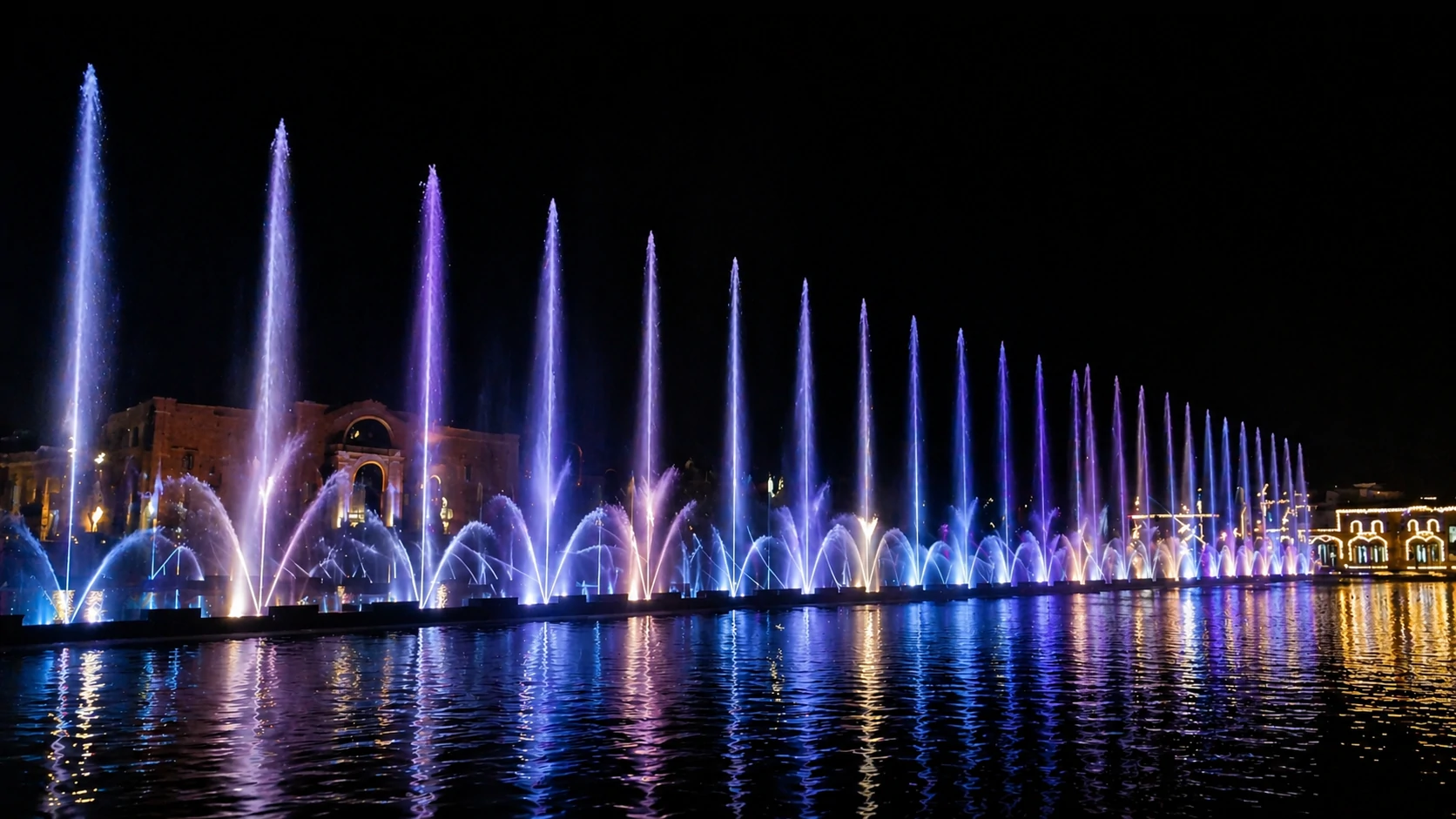
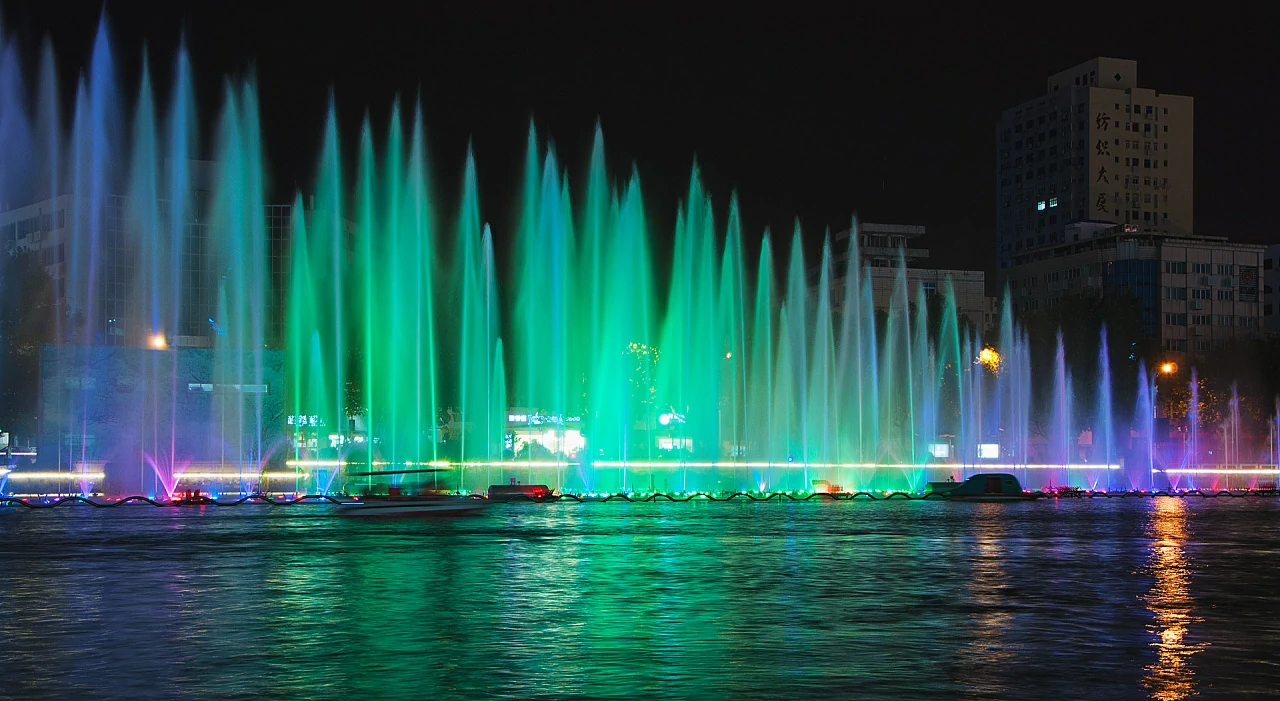
Night fountain scene with lighting and water surface reflection, showing how reflection can enhance fountain visual design.

The water surface is also part of the fountain design.
A calm water surface can reflect buildings, lights, trees, and fountain effects. This can make the space feel deeper and more elegant.
Reflection is especially important in night scenes.
To create good reflection, designers need to consider:

water surface level
pool edge height
water depth
surrounding light sources
wind direction
pool cleanliness
background buildings and landscape

In some projects, the reflection can become a major part of the visual experience.
A fountain is not only the water that sprays upward. The still water around it also affects the final result.

Practical Engineering Checks Before Final Layout

A fountain layout must be beautiful, but it must also be buildable.
Before confirming the final design, the project team should check the engineering details.
Key points include:

pool structure and depth
fountain equipment installation space
pump room position
pipe routing
cable routing
power supply
control system location
drainage and overflow
wind and splash control
access for maintenance
safety for visitors
local climate conditions

These details affect the final performance of the fountain.
A good concept can fail if the engineering plan is not clear. This is why fountain design should connect visual planning with technical design from the beginning.

From Concept to Buildable Fountain Design

A complete fountain design usually follows several steps.

The project team studies the site condition, pool size, surrounding space, viewing direction, and client requirements.

The designer confirms the main visual idea, layout direction, and project atmosphere.

The team selects suitable fountain effects based on the design goal, budget, and site conditions.

Engineers plan the hydraulic system, electrical system, lighting system, and control system.

The team prepares layout drawings, equipment drawings, pipe drawings, cable drawings, and installation details.

Core fountain equipment should be produced and tested before delivery when possible.

The fountain is installed on site. Then the water effects, lighting, music, and control programs are adjusted.

This process helps turn the design concept into a real fountain project.

Project Example: Burhoniddin Al-Margiloniy Scientific Development Center Fountain Project

To make the above fountain layout principles easier to understand, here is one project example for reference.
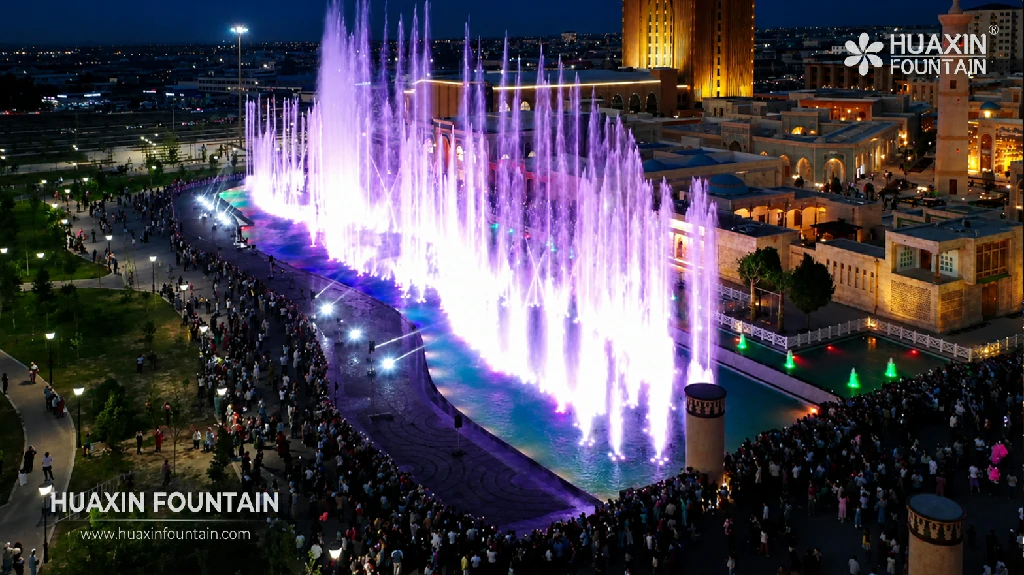
This project was designed by Huaxin Fountain for BURHONIDDIN AL-MARGILONIY ILMIY TARAQQIYOT MARKAZI. For easier English communication, we can refer to it as the Burhoniddin Al-Margiloniy Scientific Development Center Fountain Project.
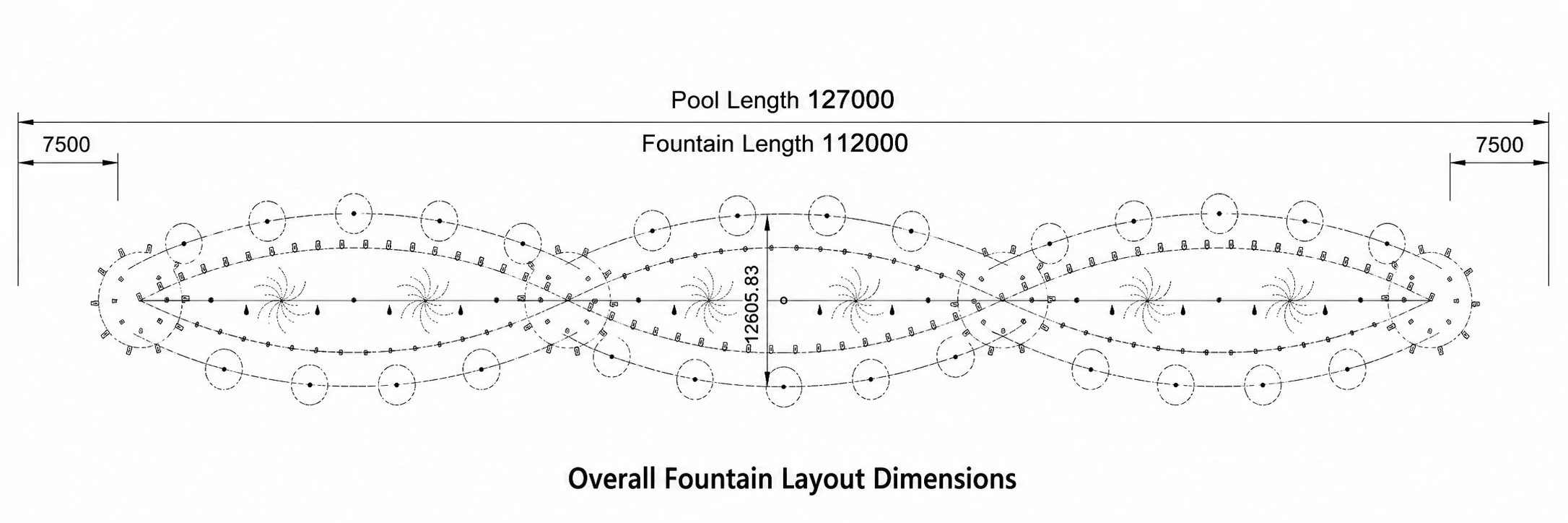
The project uses a long axial pool. The pool length is about 127 meters, and the fountain layout is about 112 meters long. About 7.5 meters of space is left at both ends of the pool.
The layout drawing below shows how the water effects are arranged inside the pool.

Fountain layout drawing showing the 127-meter pool length and 112-meter fountain layout length for the Burhoniddin Al-Margiloniy Scientific Development Center Fountain Project.
Overall fountain layout dimensions for the Burhoniddin Al-Margiloniy Scientific Development Center Fountain Project.

Layout Concept

Huaxin Fountain designed the fountain along the center line of the pool.
The layout is symmetrical and rhythmic. The main water effects are placed around the center. Supporting effects are repeated on both sides.
This makes the fountain look balanced from a distance. It also helps the long pool avoid looking empty.
For a long pool, the design should not only place effects in one area. It needs a clear center, repeated rhythm, and enough visual movement across the full length.
In this project, the center becomes the main focus. The left and right sections extend the show rhythm toward both ends of the pool.

Main Fountain Effects

The project combines water effects, lighting, and multimedia show elements.
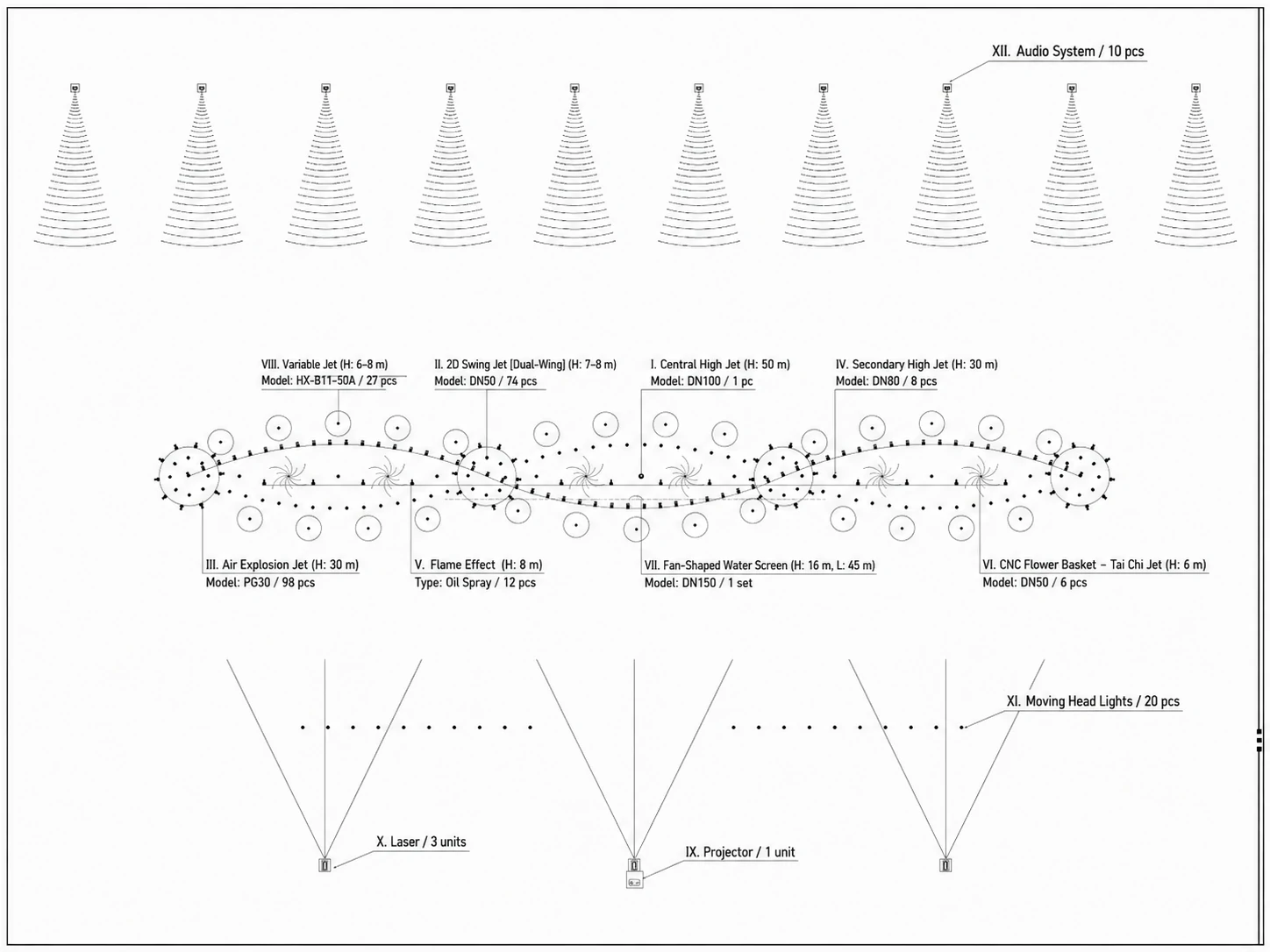
The main effects include:

Central high jet, about 50 m
Secondary high jets, about 30 m
Air explosion effects, about 30 m
Flame effects, about 8 m
Variable jet effects, about 6–8 m
2D swing fountain effects, about 7–8 m
Fan-shaped water screen, about 16 m high and 45 m long
Rotating flower-style fountain effects, about 6 m
Laser system
Projection system
Moving head lights
Audio system
Fountain effect and multimedia system layout designed by Huaxin Fountain for the Burhoniddin Al-Margiloniy Scientific Development Center Fountain Project.
Fountain effect and multimedia system layout for the Burhoniddin Al-Margiloniy Scientific Development Center Fountain Project.

Visual Layers

This project does not rely on one single type of water effect.
Huaxin Fountain used different heights, movements, and show elements to create visual layers.
The central high jet forms the highest point.
The secondary high jets support the center.
The 2D swing fountain effects add movement along the pool.
The rotating flower-style effects add detail and rhythm.
The fan-shaped water screen creates a wide visual surface.
Together, these effects make the fountain more complete than a simple row of repeated jets.

Multimedia Show Planning

The project also includes lasers, projection, moving head lights, and audio systems.
These elements are planned together with the water effects.
The fan-shaped water screen can be used as a visual surface.
The high jets can be used for key show moments.
The moving head lights and lasers can strengthen the night scene.
The audio system helps connect water movement with music.
For this type of fountain project, design is not only about water. It is also about how water, light, sound, and space work together.

Why This Example Is Useful

This project shows how fountain layout principles can be used in a real design.
The layout follows the shape of the pool.
The center is clear.
The left and right sides are balanced.
Different water effects create different visual layers.
Multimedia elements are considered from the design stage.
For project owners, designers, and contractors, this example shows why early fountain layout planning is important.
A good layout can make the project easier to understand, easier to build, and easier to control during show programming.

Case Summary

The Burhoniddin Al-Margiloniy Scientific Development Center Fountain Project is a useful example of long-pool fountain layout design.
Designed by Huaxin Fountain, the project uses a symmetrical axial layout, layered water effects, and multimedia show elements.
It shows how a long pool can become a complete fountain show space through proper layout planning.

Conclusion

Fountain layout design is a balance between art and engineering.
A successful fountain project needs more than attractive water effects. It needs a clear structure, proper scale, visual rhythm, technical coordination, and good site planning.
When water effects, lighting, music, reflection, and engineering details are planned together, the fountain can become a strong visual center for the whole space.
For project owners, designers, and contractors, early layout planning can reduce mistakes. It can also make the final fountain more stable, more beautiful, and easier to build.
You can also view more fountain projects completed or designed by Huaxin Fountain.

FAQ

Fountain layout design is the planning of water effects, spray positions, viewing angles, pool space, lighting, and technical systems. It helps turn a fountain concept into a buildable project.

Proportion affects how the fountain looks in its environment. Spray height, pool size, building scale, and viewing distance should match each other.

Designers choose water effects based on project type, pool size, budget, site conditions, visual goal, and control system requirements.

Lighting and music can be added to many fountain projects. But they should be planned together with the water effects and control system.

The project team should check pool depth, pipe routing, power supply, pump room location, control system, splash range, maintenance access, and site safety.

Делиться:

Talk with Huaxin Fountain about your project

Send us your pool size, site photos, layout drawings, and target fountain effects. Huaxin Fountain can help review the layout, equipment configuration, and show system options for your fountain project.

АДРЕС

Китай, пров. Сычуань, г. Нэйцзян, Зона экономического развития, ул. Аньтай, 399

Phone/WhatsApp/weChat/telegram

0086 18816238859

ПОДПИСЫВАЙТЕСЬ

Пожалуйста, введите ваше полное имя.
This field is required.
Пожалуйста, введите корректный номер телефона.
This field is required.
Пожалуйста, подробно опишите требования к вашему фонтанному проекту.
This field is required.
Прокрутить вверх