

Для создания гладкой, похожей на стекло струи фонтана одного лишь давления воды недостаточно. Ее внешний вид зависит от условий потока внутри насадки, стабильности водного потока в момент выхода из отверстия, а также от воздействий, которым он подвергается в воздухе.
Число Рейнольдса (Re) — полезная отправная точка для понимания этих условий. Однако само по себе оно не позволяет предсказать визуальное качество ламинарного фонтана. Также необходимо учитывать конструкцию сопла, турбулентность потока перед ним, поверхностное натяжение и условия эксплуатации.
В этой статье объясняется, как рассчитывается число Рейнольдса, почему к традиционным пределам для течения жидкости в трубах следует подходить с осторожностью и на что инженерам следует обращать внимание при проектировании ламинарных и прыгающих фонтанных струй.
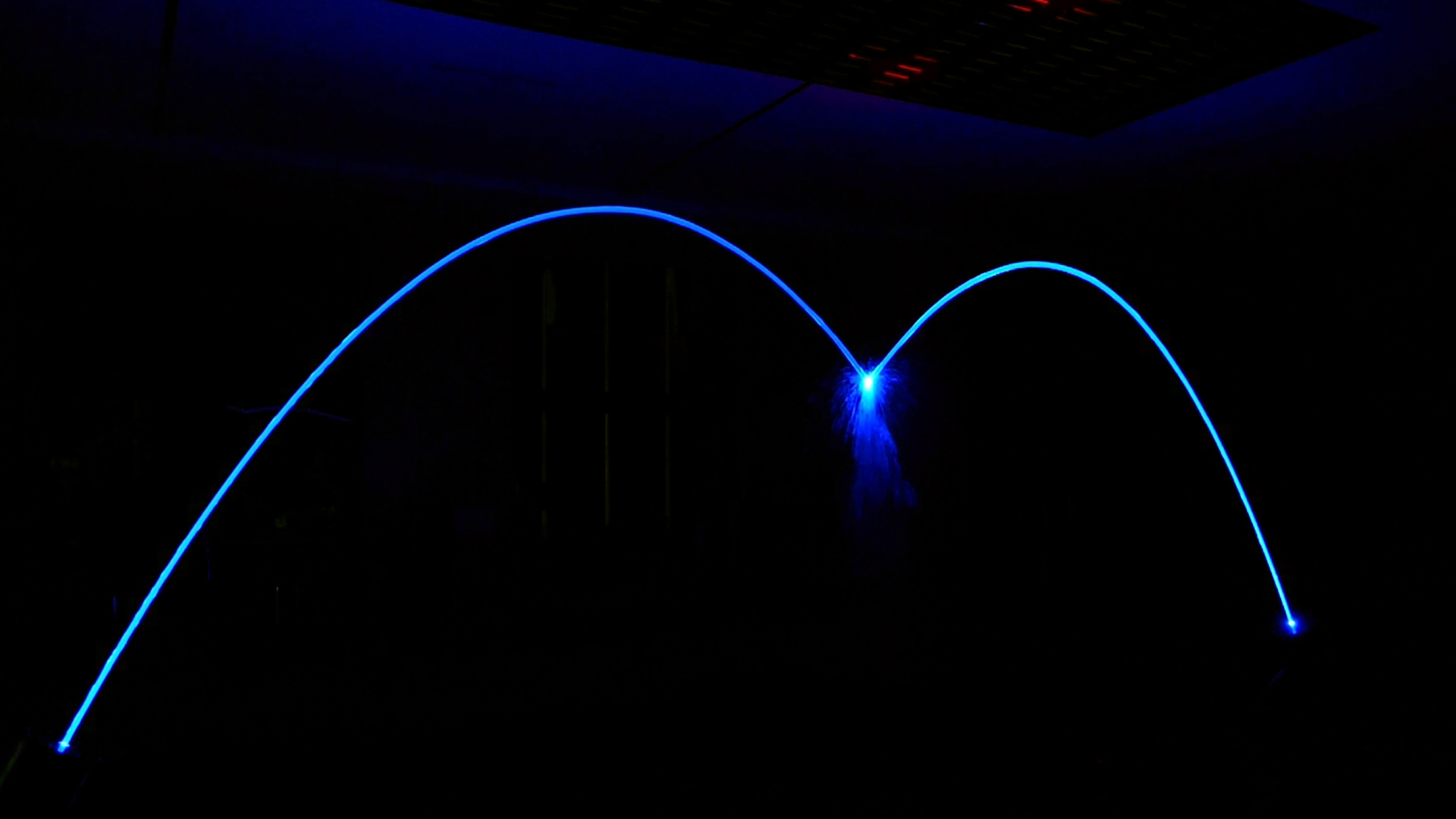
Что такое число Рейнольдса в гидравлике фонтанов?
Число Рейнольдса — это безразмерная величина, которая описывает соотношение между инерционными и вязкостными эффектами в движущейся жидкости.
Проще говоря, это помогает инженерам понять, как поток ведет себя при определенном сочетании скорости, характерного размера и вязкости жидкости.
Для потока воды в круглой трубе число Рейнольдса обычно используется для различения ламинарного, переходного и турбулентного режимов течения.
| Число Рейнольдса | Классификация потоков в трубах (традиционная) |
|---|---|
| Ниже примерно 2000–2300 | Ламинарный |
| Приблизительно 2300–4000 | Переходный |
| Примерно 4000 | Турбулентный |
Эти диапазоны представляют собой приблизительные ориентиры для потока внутри трубы. Точный момент перехода зависит от возмущений на входе, геометрии трубы и условий эксплуатации.
Их не следует использовать в качестве универсальных критериев приемлемости внешнего вида струи фонтана после ее выхода из сопла.
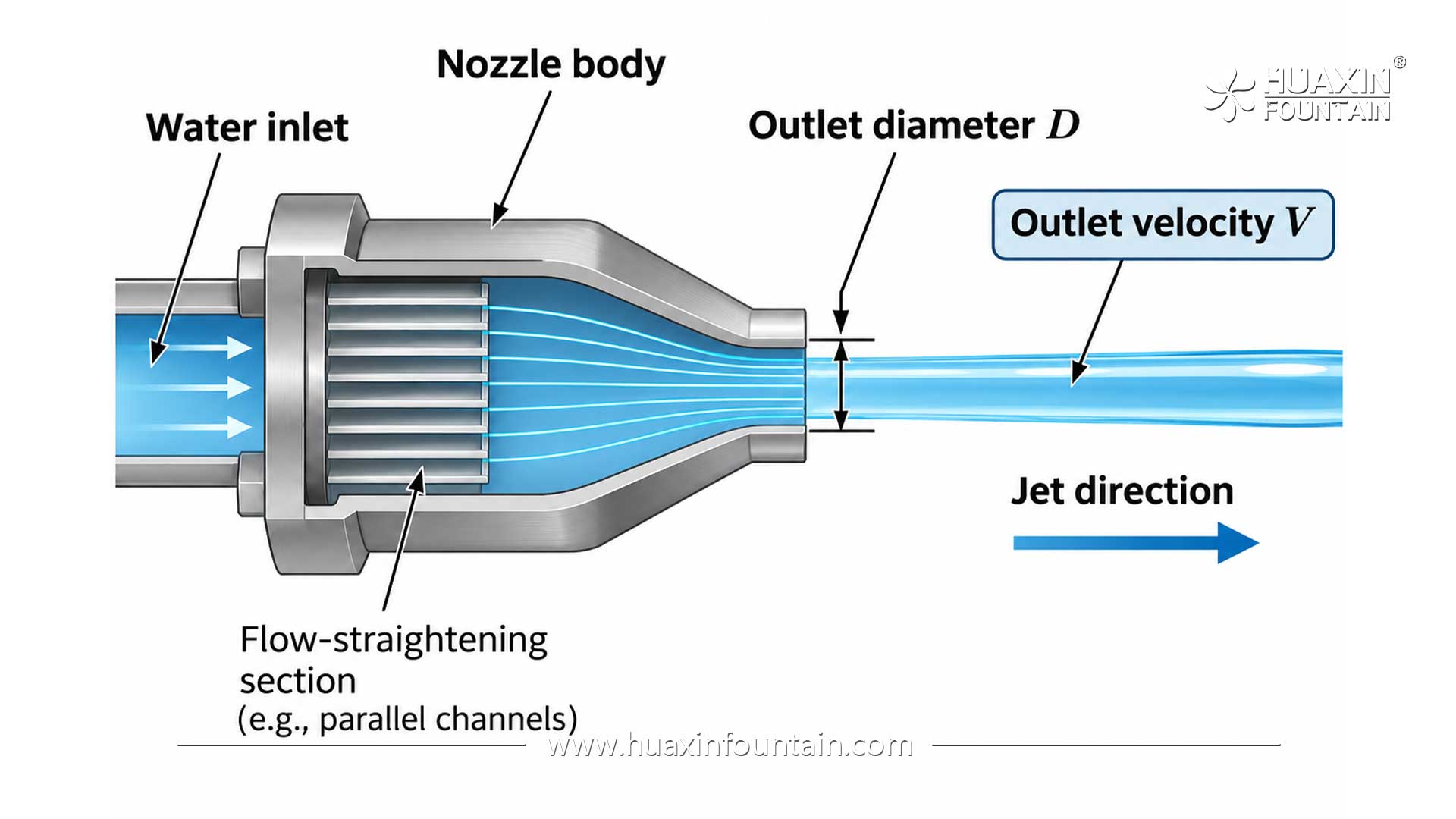
Работа фонтанной насадки — это нечто большее, чем просто полностью установившееся течение в трубе. Вода проходит через внутренние каналы, меняет направление или площадь поперечного сечения и в конечном итоге превращается в свободную струю, окруженную воздухом.
На получающуюся водную поверхность влияют условия, которые нельзя в полной мере описать с помощью одного лишь числа Рейнольдса.
Как рассчитать число Рейнольдса для фонтанной струи
Часто используемое уравнение — это:
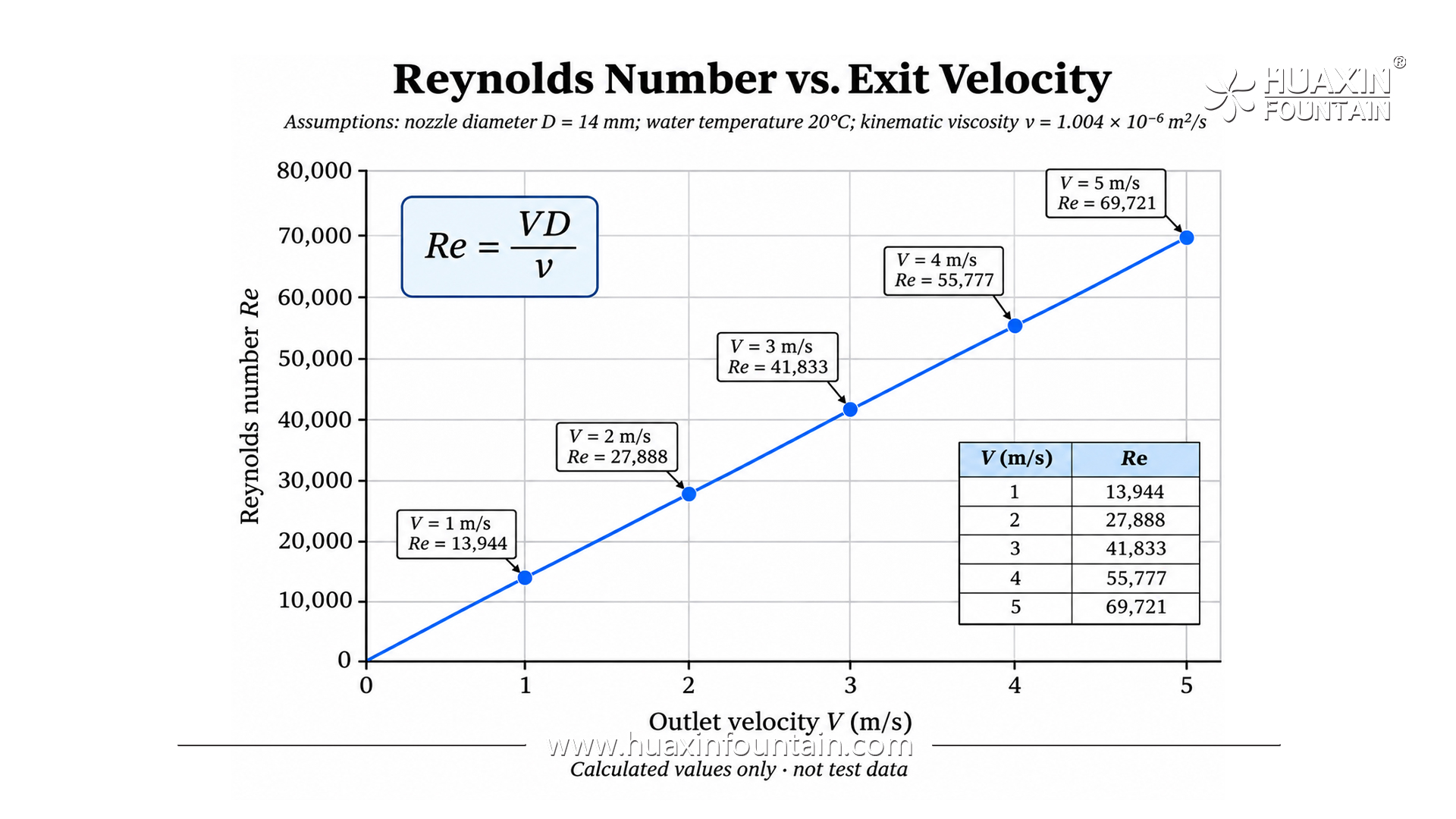
Re = VD / ν
Эквивалентная форма с использованием динамической вязкости:
Re = ρVD / μ
Где:
Re = число Рейнольдса (безразмерная величина)
V = средняя скорость воды (м/с)
D = характерный диаметр (м)
ν = кинематическая вязкость воды (м²/с)
ρ = плотность воды (кг/м³)
μ = динамическая вязкость воды (Па·с)
Для струи воды, имеющей приблизительно круговую форму, в качестве характерного диаметра при предварительном расчете можно использовать номинальный диаметр выходного отверстия.
При температуре 20 °C кинематическая вязкость воды составляет приблизительно:
ν = 1.004 × 10⁻⁶ m²/s
При использовании этого уравнения все величины должны быть выражены в согласованных единицах измерения.
Важное различие заключается в том, что Диаметр входного соединения сопла не обязательно совпадает с диаметром выходного отверстия струи.Использование входного патрубка DN40 для сопла с выходным отверстием диаметром 14 мм приведет к неверной оценке числа Рейнольдса на выходе.
Практический расчет: фонтанная насадка «струя» (14 мм)
Рассмотрим условное сопло, работающее в следующих условиях:
| Параметр | Ценить |
|---|---|
| Температура воды | 20°C |
| Диаметр выходного отверстия струи | 14 mm (0.014 m) |
| Средняя скорость на выходе | 5.0 m/s |
| Кинематическая вязкость | 1.004 × 10⁻⁶ m²/s |
Подставляя значения:
Re = (5.0 × 0.014) / (1.004 × 10⁻⁶)
Re ≈ 69,700
Для одного заполненного круглого отверстия соответствующий теоретический расход составляет:
Q = (πD² / 4) × V
Q ≈ 2.77 m³/h
В этом примере используются условные рабочие параметры исключительно для иллюстрации. Приведённые данные не являются результатами измерений характеристик конкретной насадки Huaxin.
Рассчитанное число Рейнольдса значительно превышает диапазон, характерный для ламинарного течения в трубе.
Означает ли это, что вода должна немедленно превратиться в брызги?
Необязательно.
Рассчитанное значение указывает на относительную интенсивность инерционных и вязких эффектов. Само по себе оно не дает информации о том, насколько гладкой будет поверхность струи или на какое расстояние она распространится, прежде чем распасться.
На результат также влияют начальное распределение скоростей, внутренние возмущения, геометрия сопла и условия окружающего воздуха.
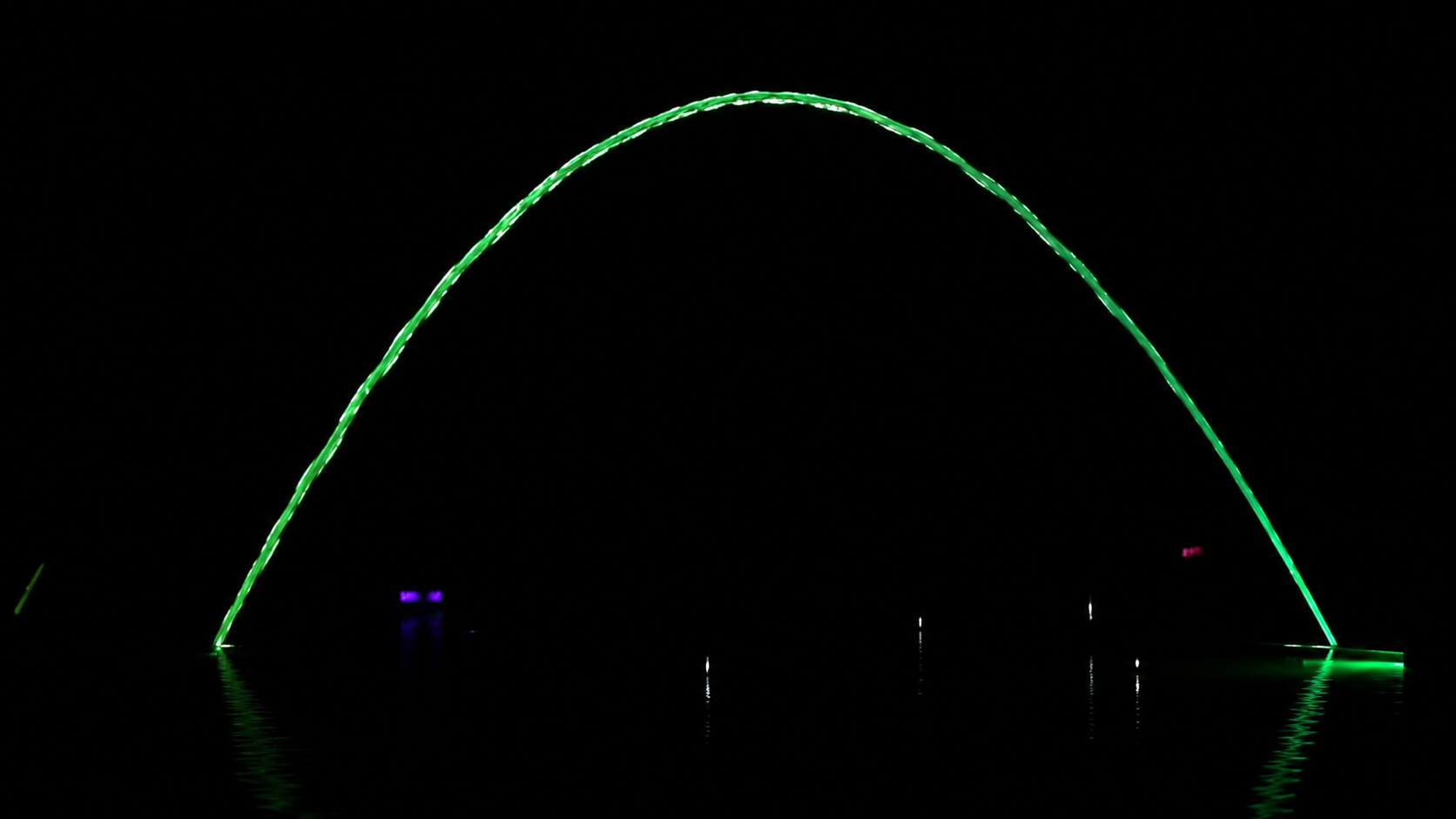
Почему низкого числа Рейнольдса недостаточно для получения струи, подобной стеклу
В некоторых традиционных справочных материалах по проектированию фонтанов число Рейнольдса ниже 500 указывается как благоприятное условие для получения прозрачной водяной струи с ламинарным характером течения.
Низкое число Рейнольдса действительно может быть связано с упорядоченным течением при определенных условиях. Однако, Число Рейнольдса (Re) ниже 500 не следует рассматривать как универсальное требование для коммерческого оборудования ламинарных фонтанов..
Рассмотрим предыдущий пример с выходным отверстием диаметром 14 мм.
Чтобы число Рейнольдса оставалось равным 500 при 20 °C, средняя скорость на выходе должна составлять приблизительно 0.036 m/s.
Столь низкая скорость обеспечила бы крайне малый импульс, недостаточный для создания сколько-нибудь значительной водяной дуги.
Для практических конструкций фонтанов необходима достаточная выходная скорость, чтобы струя достигла заданной высоты и точки падения.
Это создает важное различие между двумя идеями:
Классификация гидравлических потоков
Научное описание движения жидкости, основанное на заданных условиях и измеримых параметрах потока.
Визуальная струйная когерентность
Видимая непрерывность и гладкость поверхности водяного столба во время его движения сквозь воздух.
Упорядоченный поток может существовать на конечном расстоянии, даже когда его число Рейнольдса превышает диапазон, обычно связываемый с ламинарным течением в трубе.
Это не означает, что поток является ламинарным в строгом научном смысле. И это также не означает, что турбулентностью можно пренебречь.
Это означает, что число Рейнольдса следует рассматривать в совокупности с физическими условиями конкретного сопла и струи.
Исследования водяных струй показали, что условия потока перед соплом и геометрия самого сопла могут оказывать существенное влияние на возмущения поверхности струи, а также на расстояние, на котором струя сохраняет свою целостность.
В сфере проектирования фонтанов Требуемый результат — это не просто низкое расчетное число Рейнольдса. Это достаточно плавная и стабильная водяная дуга в заданных рабочих условиях.
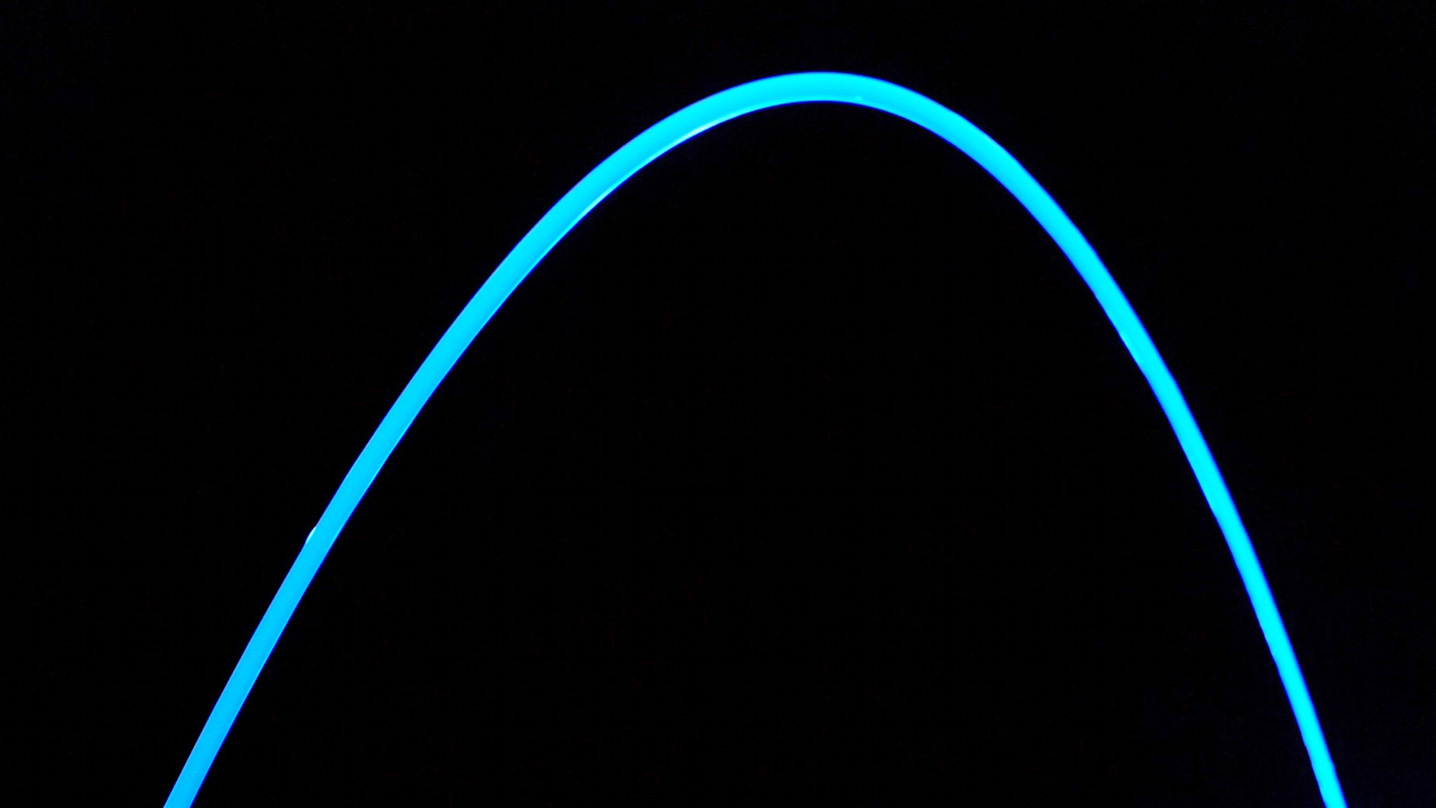
Сравнение плавной, целостной струи воды и потока с заметными нарушениями структуры. Изображения приведены для наглядности и не являются результатами контролируемых гидравлических испытаний.
Что на самом деле определяет качество ламинарной струи фонтана?
Several factors influence whether a fountain jet retains its glass-like appearance.
1. Flow Conditioning Inside the Nozzle
Water supplied by a pump may contain velocity fluctuations, swirling motion, and disturbances created by bends, valves, and other components.
A laminar fountain unit is designed to condition the incoming flow before the water reaches the outlet.
Depending on the equipment design, internal passages and flow-straightening elements can help reduce undesirable motion and produce a more controlled exit flow.
The effectiveness of these elements depends on their geometry and on the operating flow rate.
Flow conditioning does not automatically guarantee a fully laminar flow state. Its practical role is to improve the conditions from which the visible water jet forms.
2. Outlet Geometry and Surface Condition
The final outlet shapes the boundary between the water and the surrounding air.
Outlet geometry influences the velocity distribution and the disturbances introduced as water leaves the nozzle.
Uneven surfaces, poor alignment, or damage near the outlet can affect jet symmetry and produce visible irregularities.
The outlet should therefore be evaluated as a hydraulic component, not simply as a hole with a specified diameter.
3. Stable Water Supply
A nozzle with effective internal flow conditioning can still produce an unstable arc if the upstream supply fluctuates excessively.
Potential sources of disturbance include:
The pump, pipework, valves, and nozzle must be considered as a connected system.
For equipment selection, the listed pump head should not be confused with the actual velocity at the nozzle outlet. The final hydraulic calculation must account for system losses and operating conditions.
4. Water Quality and Entrained Air
Water clarity and hydraulic stability are related but different issues.
Suspended particles may reduce optical clarity, even if the jet surface is smooth. Entrained air bubbles can scatter light and disturb the visible appearance of the stream.
Filtration, water circulation, and the prevention of unwanted air entry therefore play important roles in maintaining the effect.
A fountain can have a mechanically stable jet and still appear cloudy because of water-quality problems.
5. Environmental Conditions
Once water leaves the nozzle, it is exposed to gravity, air resistance, and wind.
Surface disturbances may grow as the jet travels. Eventually, the continuous water column can break into droplets.
A fountain jet that appears smooth near the outlet may show waves or breakup farther along its arc.
This is why performance should be observed over the entire required trajectory, rather than only at the nozzle exit.
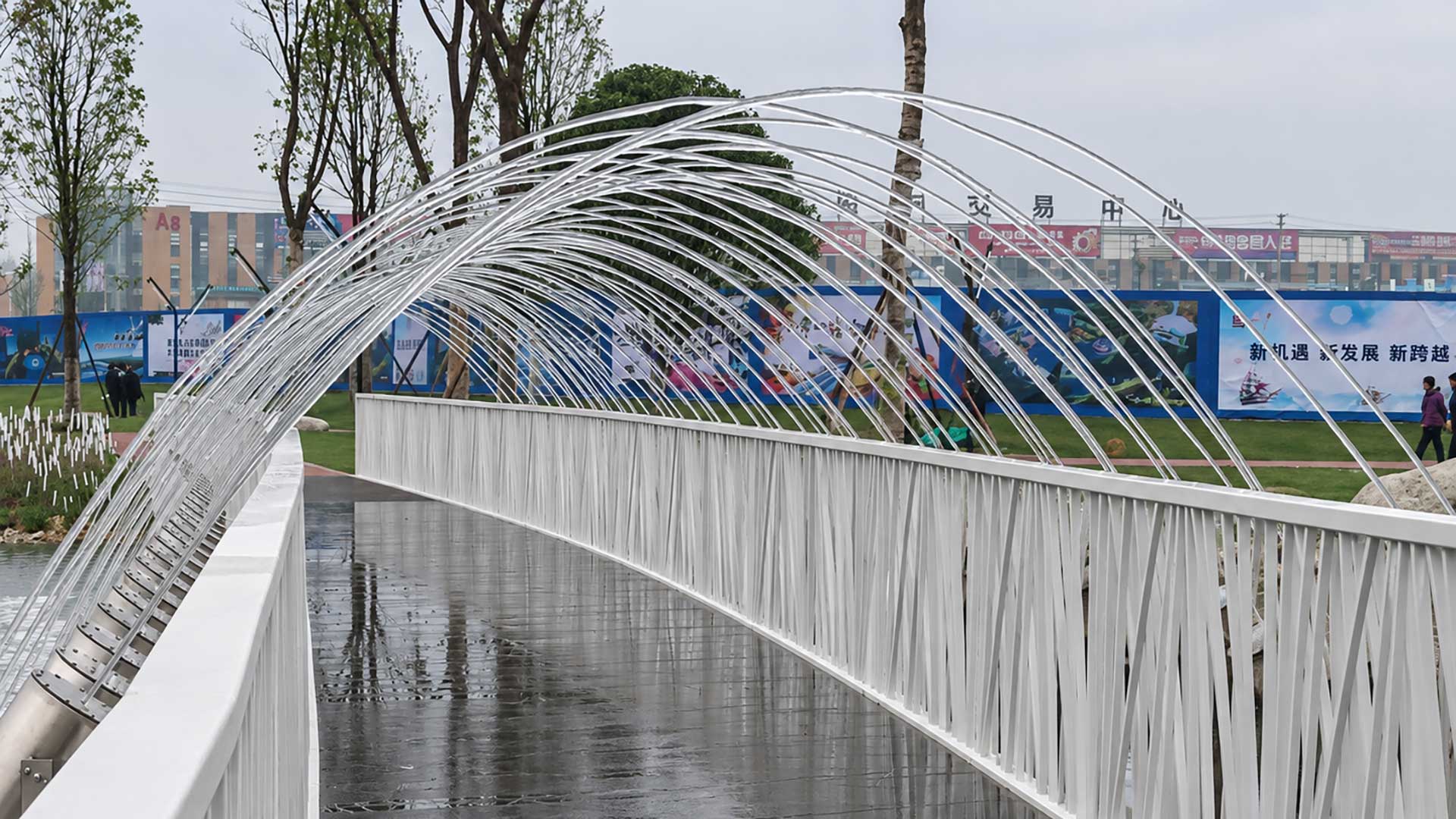
Число Рейнольдса — не единственный параметр: роль поверхностного натяжения
Reynolds number compares inertial and viscous effects. It does not directly describe the balance between inertia and surface tension at the water-air interface.
For that purpose, engineers may also consider the Weber number (We):
We = ρV²D / σ
Where σ is the surface tension of water (N/m).
Surface tension helps resist deformation of the water surface. Disturbances can grow along a liquid jet and contribute to its eventual breakup.
The breakup process depends on several interacting factors, including the initial disturbance level, velocity, jet diameter, viscosity, and surrounding air conditions.
Neither Reynolds number nor Weber number alone gives a universal prediction of the visible continuous length of every fountain nozzle.
For a project requiring a long, clear water arc, numerical calculations provide a starting point. Actual jet observations under representative conditions are also important.
Как это применимо к «прыгающим» струям фонтана?
A conventional laminar fountain jet is intended to form a continuous water arc.
A jumping fountain jet adds another function: it intentionally divides the water stream into separate sections.
The hydraulic principle behind producing a smooth stream remains relevant. However, an internal cutting mechanism introduces controlled interruptions to create the jumping effect.
The cutting sequence determines when water is separated. The hydraulic system determines how the water behaves before, during, and after those interruptions.
For a successful jumping effect, engineers should examine three aspects:
Stream quality before cutting. The water should form a sufficiently stable and defined arc under the operating conditions.
Segment formation. The cutting mechanism must produce the intended separation and timing without excessive irregularity.
Recovery after cutting. The water stream should return to its intended continuous shape between cutting events, within the required sequence.
This distinction is important. A jumping jet is not simply an ordinary fountain nozzle with faster pump switching.
Huaxin’s Прыгающие Ламинарные Фонтаны use an internal cutting mechanism to produce separated water segments. Standard, submersible, and laser-illuminated configurations are available for different project layouts.
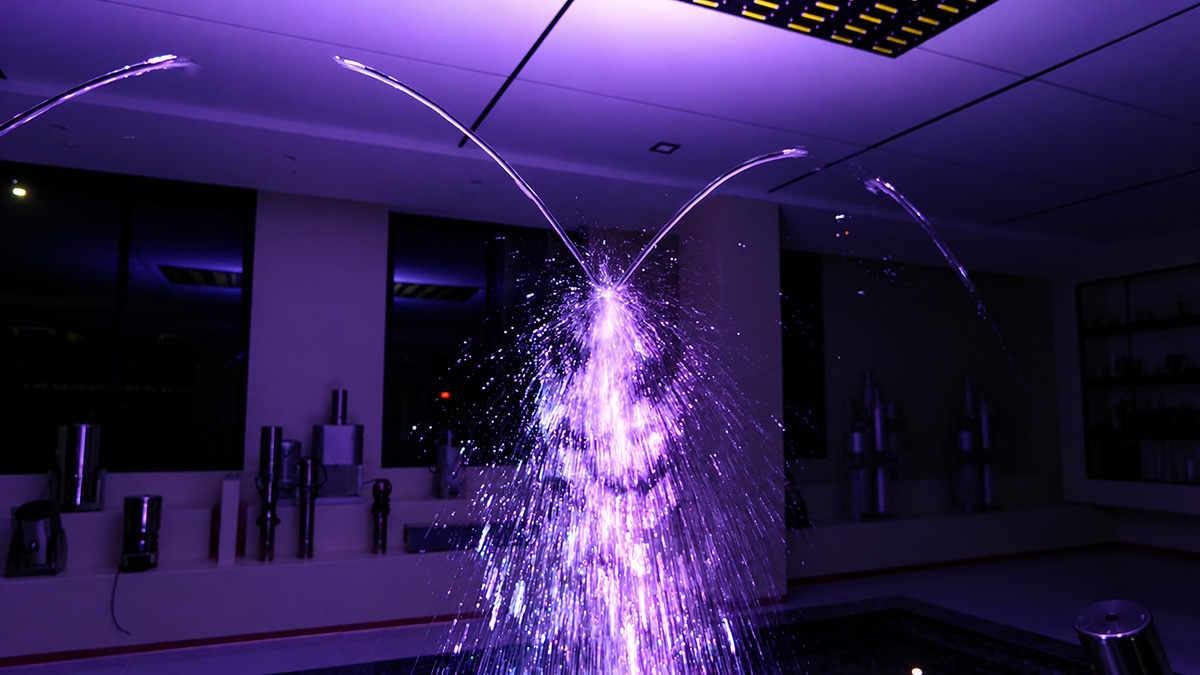
Меняет ли освещение гидравлические требования?
Lighting changes how a water arc is perceived, but it does not eliminate the need for stable hydraulic conditions.
A smooth water-air interface can help preserve a visually defined illuminated stream. Irregular surfaces, bubbles, and droplets can scatter light and change its appearance.
For this reason, a brighter light source cannot always compensate for an unstable water jet.
A laser-illuminated configuration may improve the visibility of the water effect under certain viewing conditions. Its actual appearance still depends on the interaction of the light source, water quality, flow stability, and surrounding illumination.
Huaxin offers Ламинарные Фонтанные Насадки in standard, submersible, and laser-illuminated versions.
Selection should be based on the desired visual result and the hydraulic and installation conditions, rather than lighting output alone.
Как инженерам следует оценивать эффективность ламинарной струи?
Calculating the Reynolds number is useful during preliminary hydraulic analysis. But practical evaluation should go further.
A structured evaluation can include the following checks.
| Evaluation item | What should be examined? |
|---|---|
| Outlet conditions | Jet diameter, actual flow rate, and operating pressure |
| Water arc | Height, span, landing position, and surface continuity |
| Visual quality | Transparency, surface irregularities, visible droplets |
| Flow stability | Sensitivity to pump fluctuation and air entrainment |
| Operating range | Performance at relevant flow settings |
| Jumping sequence | Segment consistency, timing, and stream recovery |
| Site conditions | Wind exposure, water quality, water level, and viewing conditions |
Testing should be carried out under documented conditions.
A useful test record identifies the nozzle configuration, water temperature, flow rate, pressure measurement location, and observed jet behavior.
For jumping jets, video is particularly valuable because static photographs cannot show cutting timing and recovery reliably.
For project-specific designs, the target height and span also need to be coordinated with the overall fountain layout.
Часто задаваемые инженерные вопросы
No. Re below 500 is not a universal requirement for commercial laminar fountain jets. A nozzle must be evaluated using its actual hydraulic conditions, flow quality, and required visual performance.
No. A high Reynolds number indicates stronger inertial effects relative to viscous effects. Jet breakup also depends on the initial disturbances, nozzle geometry, surface tension, and surrounding conditions.
Possible causes include entrained air, suspended particles, unstable water supply, outlet contamination, or excessive disturbances within the water stream. These conditions should be investigated individually.
No. Nozzle selection also requires the target jet height, span, outlet diameter, flow rate, pressure conditions, water level, installation arrangement, and any lighting or jumping functions.
Инженерное заключение
Reynolds number is an important hydraulic parameter, but it should not be treated as a direct measure of fountain water clarity.
A glass-like fountain jet depends on the combined behavior of the nozzle, water supply, free jet, and surrounding environment.
For continuous laminar arcs, the engineering goal is a stable and visually defined stream over the required distance. For jumping jets, consistent segment formation and controlled recovery must also be considered.
The most reliable design approach combines hydraulic calculations, suitable equipment geometry, and practical performance verification.
Huaxin Fountain manufactures ЛАМИНАРНЫЕ И ПРЫГАЮЩИЕ СТРУИ for commercial fountain projects and programmed water shows. Project-specific equipment selection should be based on the intended effect, operating conditions, and installation requirements.
For further technical and project-planning guidance, visit the Huaxin Fountain Knowledge Center.
Технические справочные материалы
1. National Institute of Standards and Technology (NIST). Guide to the SI, Chapter 8. Reference for viscosity units and symbols.
2. Sengers, J. V., and Kamgar-Parsi, B. (1984). Representative Equations for the Viscosity of Water Substance. Journal of Physical and Chemical Reference Data, 13(1), 185–205.
3. Falvey, H. T. (1980). Air-Water Flow in Hydraulic Structures. Engineering Monograph No. 41, U.S. Bureau of Reclamation. See the discussion of free-falling water jets.
4. The Effect of Nozzle Design on the Stability and Performance of Turbulent Water Jets. Fire Safety Journal, 1981.
5. A Short Note about the Impact Action of a Water Jet Stabilized by a Coaxial Air Stream in the Air and Underwater. Materials, 2021. Discussion of Reynolds number, Weber number, and liquid-jet breakup.
Technical note: The numerical example in this article is an illustrative calculation, not a certified performance test or acceptance criterion for any specific fountain equipment.
Need Help Selecting a Laminar Fountain Jet?
Share your required jet height, span, installation conditions, and lighting preferences. Huaxin Fountain can help review suitable laminar or jumping jet configurations for your project.