Home » Resources » Fountain Knowledge Center » Applications & Design

Fountain Applications & Design

Explore how site conditions, spatial layouts, viewing requirements, and operational needs influence the design of commercial and public fountain systems.

Fountain design is not simply a matter of choosing water effects. The same equipment may be used in different environments, but its arrangement, operating requirements, and visual impact can vary significantly.

This section of the Huaxin Fountain Knowledge Center brings together design guidance, layout principles, and technical references for developing fountain concepts that respond to real project conditions.

How Application Conditions Shape Fountain Design

Different fountain applications introduce different design challenges.
Rather than selecting a fountain layout solely by project type, designers should examine how the available space will be used, where audiences will stand, and which physical constraints must be addressed.

Application conditionDesign implications
Fixed circular or rectangular poolWater-effect grouping, viewing directions, pool boundaries, and visual composition
Long or narrow water featureDistribution of effects, sequence continuity, viewing distance, and visual rhythm
Open public plazaPedestrian access, dry-deck integration, drainage, operating zones, and safety
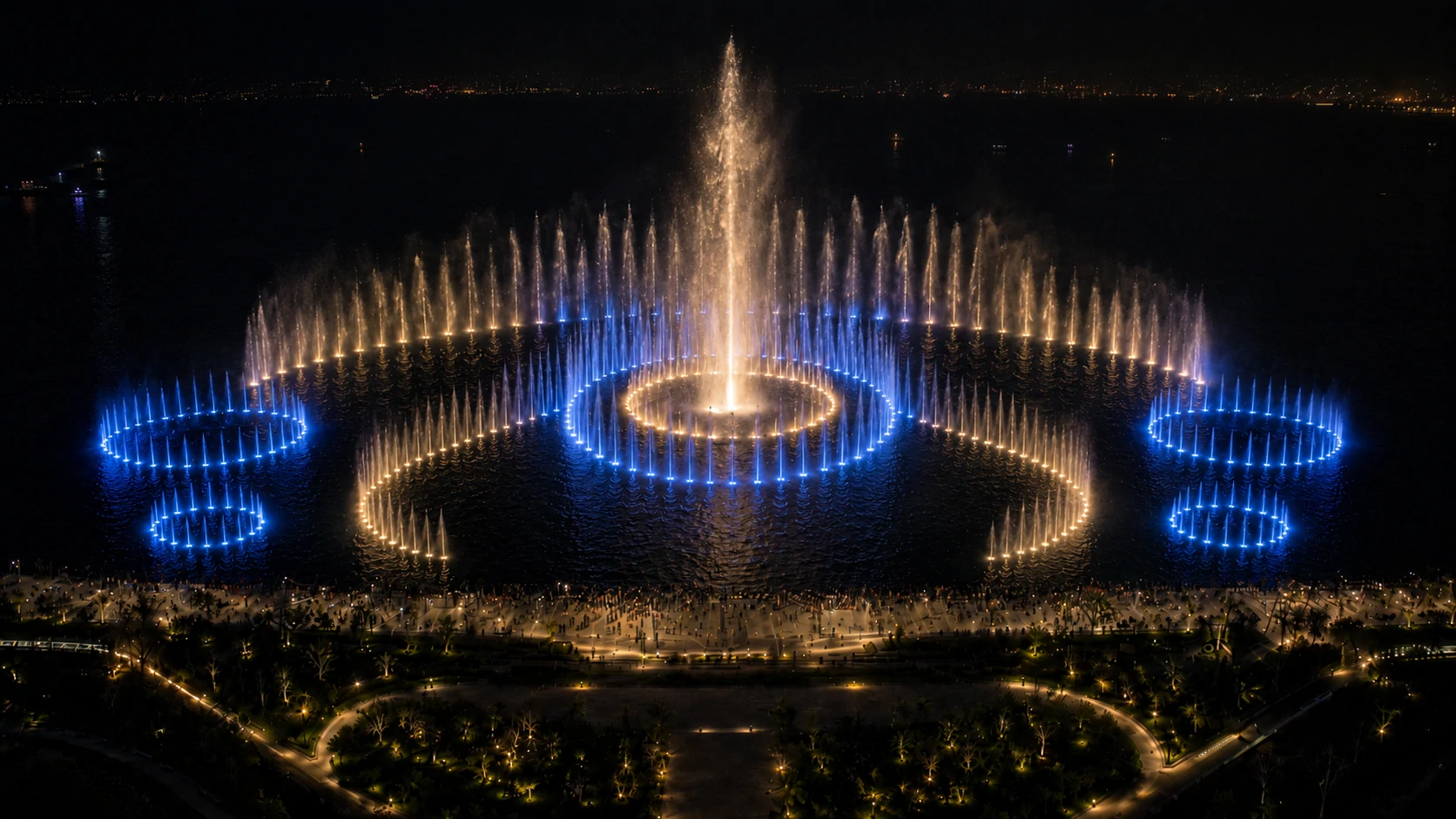
Lake or large water bodyInstallation configuration, changing water levels, environmental exposure, and distant viewing
Resort or entertainment destinationMultiple viewing positions, show visibility, lighting, and operational scheduling
Multimedia performance areaAudience orientation, water-screen placement, projection conditions, and synchronization

These conditions do not prescribe a single design solution. They identify the questions that need to be resolved before a suitable layout and equipment configuration can be developed.

Four Key Considerations in Fountain Applications

The available space influences the physical arrangement of the fountain system.

A conventional pool allows equipment to be integrated within a defined water area. A dry-deck fountain requires coordination with the finished ground surface and below-grade infrastructure. A floating lake fountain introduces a different set of installation and environmental considerations.

The design must respond to the actual installation environment rather than assume that a standard arrangement will suit every location.

The way visitors experience a fountain influences its visual organization.

Some installations are primarily viewed from one direction. Others must remain visually coherent from multiple sides or along an extended walking route.

Designers should consider whether the audience is stationary, moving around the installation, or viewing the fountain from elevated or distant locations.

Water effects should be selected according to the intended visual function.

A fountain designed for continuous daytime operation may have different priorities from one intended for scheduled nighttime performances.

Moving water effects, high jets, sequential patterns, laminar arcs, and multimedia elements each introduce different requirements for space, hydraulic design, controls, and operating conditions.

For a detailed explanation of visual hierarchy, symmetry, proportion, and water-effect combinations, read our Fountain Layout Design Guide.

The appearance of a fountain is only one part of its design.

Equipment accessibility, water management, wind exposure, public safety, operating schedules, and maintenance arrangements can influence the final layout.

These requirements are particularly important when fountain equipment shares space with pedestrian areas, landscape structures, or other building systems.

From Application Requirements to Technical Layouts

A fountain concept becomes useful for engineering when the proposed design can be represented through clear drawings and defined system requirements.
The design information may include:

Design informationPurpose
General arrangement drawingEstablishes the overall layout within the available site
Water-effect positioningIdentifies fountain groups, approximate positions, and intended visual functions
Equipment arrangementSupports coordination of nozzles, pumps, drives, lighting, and related components
Operating and movement requirementsDefines the intended effect functions and relevant movement or operating conditions
Installation interfacesIdentifies areas requiring coordination with civil, hydraulic, and electrical works

The level of detail depends on the design stage and the agreed project scope. A preliminary concept drawing should not be treated as a final installation drawing.

Fountain Design Guides & Technical Resources

Explore detailed guidance on the principles and practical development of fountain designs.

Related Engineering Knowledge

Fountain design connects visual planning with several other technical disciplines.

Fountain Project Planning

For early project preparation, including site information and coordination responsibilities, visit Fountain Project Planning.

Engineering & Technology

To explore hydraulic principles, water-jet behavior, and control technology, visit Engineering & Technology.

Fountain Types

For an overview of the main commercial fountain system types, explore Fountain Types.

Discuss Your Fountain Design Requirements

If you are evaluating a fountain concept for a commercial development, public space, resort, or entertainment destination, Huaxin Fountain can help review the available drawings and discuss possible system arrangements.

Share your site layout, approximate dimensions, preferred water effects, viewing requirements, and any existing design information.

Our team can help assess suitable design directions and related equipment requirements according to the project scope.

Scroll to Top