Home » Resources » Fountain Knowledge Center » Engineering & Technology

Fountain Engineering & Technology

Technical knowledge covering fountain hydraulics, water jet behavior, pumping systems, electrical engineering, and programmable fountain control.

Fountain performance depends on how these systems work together. Water pressure and flow affect jet behavior, while electrical and control systems determine how equipment operates and responds to programmed sequences.

This section of the Huaxin Fountain Knowledge Center explores the engineering principles, calculations, and technical considerations behind commercial fountain systems.

Explore Engineering Topics

Find updates related to different stages of our manufacturing operations and fountain project delivery.

Hydraulics & Water Jet Behavior

Understand how water velocity, flow rate, pressure, and nozzle geometry influence fountain performance.

Topics include Reynolds number, laminar jet stability, nozzle discharge characteristics, theoretical jet height, and the factors that affect water behavior after it leaves the nozzle.

Hydraulic calculations provide a starting point for engineering decisions, but actual jet performance also depends on equipment geometry, upstream flow conditions, and site conditions.

Pumps & Piping Systems

Explore the hydraulic relationship between pumps, pipework, valves, and fountain nozzles.

Engineering topics include total dynamic head, pipe friction losses, local resistance, pump operating points, and flow distribution across multiple fountain zones.

Correct pump selection requires more than matching a nominal spray height. Engineers must also consider hydraulic losses, the nozzle’s operating requirements, and the performance characteristics of the complete system.

Control Systems & Show Programming

Learn how fountain control systems coordinate pumps, valves, moving jets, lighting, and multimedia effects.

Topics include programmable logic controllers (PLCs), DMX512 communication, variable-frequency drives (VFDs), control signal distribution, and music synchronization.

These systems perform different functions. Understanding their roles helps project teams develop suitable control architectures for both equipment operation and programmed water shows.

Electrical & Lighting Systems

Explore electrical and lighting considerations for commercial fountain installations.

Topics include electrical load assessment, power distribution, protective devices, underwater lighting, control cabling, and equipment interfaces.

Fountain lighting also involves optical design. Light output, beam angle, positioning, water conditions, and ambient illumination all affect how water effects appear during nighttime operation.

Electrical design and installation must follow the applicable codes, project specifications, and equipment requirements.

Key Engineering Parameters in Fountain Systems

Fountain engineering involves several interconnected parameters. Understanding what each parameter describes helps project teams interpret calculations, equipment data, and technical proposals.

ParameterEngineering significance
Flow rate (Q)The quantity of water delivered through a nozzle, pipe, or system within a given period
Pressure (P)The pressure available at a defined point in the hydraulic system
Total dynamic head (H)The head required for the intended operating condition, including relevant elevation and hydraulic losses
Reynolds number (Re)A dimensionless parameter comparing inertial and viscous effects in fluid flow
Pump operating pointThe actual flow and head at which a pump operates within the connected hydraulic system
Control responseThe way an actuator or water effect responds to a command, including physical delays and operating limits

These parameters are connected, but they are not interchangeable.

For example, a pump’s rated head does not directly represent the height of a fountain jet. The final jet also depends on nozzle characteristics, hydraulic losses, available energy, and operating conditions.

Likewise, a calculated Reynolds number does not independently establish whether a free water jet will maintain a smooth, glass-like appearance throughout its trajectory.

Technical calculations should therefore state their assumptions, units, reference conditions, and limitations.

Engineering Guides & Calculations

Explore technical articles covering the principles and calculations used in fountain engineering.

Our engineering guides focus on defined questions, from understanding the flow behavior of laminar jets to evaluating hydraulic requirements and fountain control technologies.

Where relevant, individual articles explain the equations, input parameters, calculation methods, and practical considerations involved.

From Engineering Principles to Fountain Equipment

Engineering principles become meaningful when they are applied to actual equipment and operating conditions.

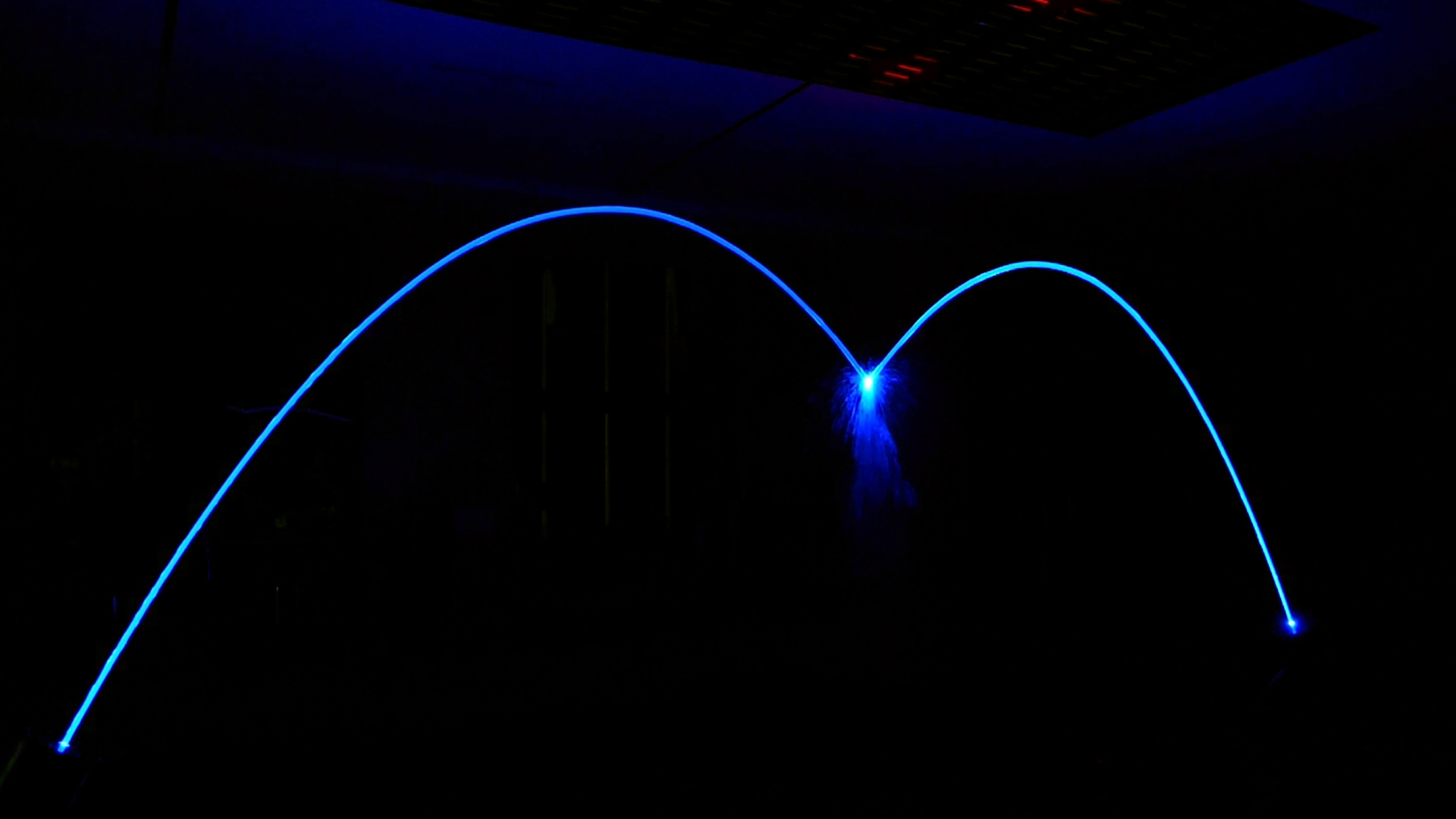
For example, the performance of Laminar Fountain Jets depends on the interaction of water supply, internal flow conditioning, nozzle geometry, and the surrounding environment.

Programmable moving water effects introduce additional requirements for actuator response, control signals, and hydraulic coordination. These factors influence how a fountain show is programmed and how consistently the intended movement can be reproduced.

Explore Huaxin Fountain’s Fountain Equipment to understand the available equipment families and their applications.

For a broader explanation of how technical systems fit within a complete project, see How to Plan a Musical Fountain Project.

Need Engineering Support for Your Fountain Project?

Developing or reviewing a fountain system for a commercial or public space?

Huaxin Fountain provides equipment manufacturing, fountain design support, control system integration, and technical coordination for project-specific fountain installations.

Share your preliminary drawings, intended water effects, equipment requirements, or technical specifications with our team.

We can review the information and discuss suitable equipment configurations and engineering considerations for your project.

Scroll to Top